We Need to Teach AI Differently
We can’t teach AI the way we taught Windows; the old models just don’t apply.
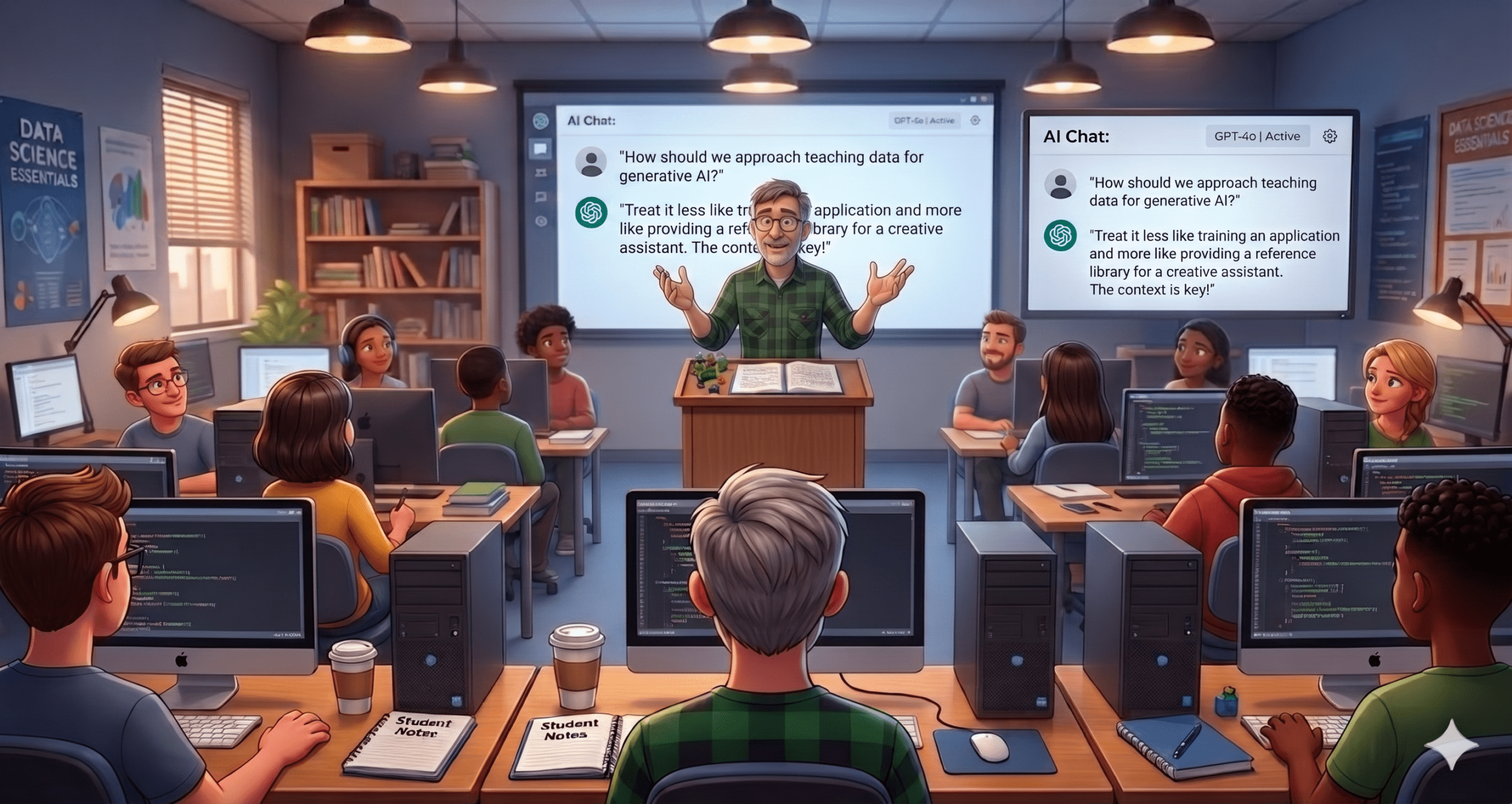
I think a lot about how to teach technology to people. I’ve been doing it for over 15 years. Lots of hours agonizing over what order to do things. Has anything changed since the last time I taught the class? Once I did have something update in the middle of a class, thankfully only once though. Hours spend testing and trying demos. Will this work, will that work. Can this be installed and set up on the lab computers.
I’ve also spent a lot of time in corporately mandated training—learning how to use Outlook, Office, a new HR system, whatever. I was usually thoroughly bored, mostly because I already knew how to use the tools, but also because everything you do in Windows, Office, Outlook, or any of those things could be followed like a recipe. It was prescriptive. There weren’t too many gray areas to worry about.
You want to send a new email? Here’s the button you click to create a new email. Here’s where you put a subject. Here’s how you add someone to the To line, the CC line, and if they’re not in the company, here’s how you paste it in. Here’s where you type in the message, and if you want to use formatting or attach a file. Very formulaic. No need for lots of other examples. People could figure it out. (Mostly).
The mental models for email, word processing, spreadsheets, even graphic design tools were grounded in concepts from the “real” world. If you knew how to type—except for the two spaces after a period thing—using Word made sense. If you addressed a letter, email made sense. Most importantly, you could do the same thing, over and over and over again and get the exact same result (yeah, I know, most of the time).
But here’s where it changes with AI. When I’m teaching a class, if I were able to see everyone’s screens simultaneously, with everyone using the exact same input, the exact same prompt, and the exact same AI tool, the chances of everyone getting the exact same output are slim to none. This is really upsetting for people who expect computers to have prescriptive outputs. If people are expecting that “if I do this, it’s going to work the same way every single time,” and AI doesn’t.
Which makes teaching AI even more challenging.
Nothing like it before
Unlike pretty much every piece of software I can think of from the past 30 plus years, there hasn’t been anything like AI before. Sure we use chat (words) to work with it, but what and how it’s working—nothing like it. There isn’t much to ground ourselves in. I’ve heard people use “world’s smartest, Ph.D.-level intern” and “a chef who knows every recipe, every ingredient in the world, but can’t taste anything” to help people understand what the current LLM-based AI tools do.
I think they all still fall short. No, I don’t have a better one either (I tend to use the Ph.D.-level intern one a lot).
Without a mental model to ground ourselves and learners and teachers, it’s hard to get the point across. It’s hard to explain why things go sideways sometimes. Why, for example, did the Gemini Gem I’ve been using for months to make cartoon images suddenly give me terrible results? Part was the prompt (my bad), but that doesn’t explain all bottles of ink with two openings or me having three arms.
What was up?
Maybe a new model was being tested? Maybe the launch of the new Mac desktop app made things a little off? No clue.
Am I going to have Gemini refactor the prompt for the Gem to fix things?
You bet I am.
But how do you teach that? How do you explain to someone who works in Excel all day long that sometimes, sometimes, Claude will choke on the CSV file it read just fine last time?
I try, but I always feel like my answer “well, sometimes it happens. happened to me yesterday” isn’t very comforting. Of course the tools and models are getting better and better all the time, but that little bit of probability will always come back and bit you on the butt when you least expect it.
No mental model, no proscribed outputs, so what am I learning?!
With AI, you are learning a new mental model of fundamental thought processes—how to work with tools respond based on probability. It’s math, not magic, and it’s a probability engine. You’re learning that you don’t have to accept what the AI responds with. You don’t have to take its suggestion for the next step.
The AI might say something like: “Based on your request, would you like me to do this thing next?” But that may not actually be what you want. You have to recognize that the AI doesn’t know what your mindset is. It’s offering something based on probability—in millions of times someone has asked to do this task, the next task they asked was something like that. So the AI offers that, and you have to decide whether to accept it or say, “No, I’m not going to do that right now. What I actually want you to do is this next step, and then this next step after that.”
Sometimes what the AI offers is really helpful; especially when you’ve told it to ask you clarifying questions. I’ve found that the majority of questions an AI asks me make me think more deeply about what I want to do. That co-creator mentality.
“Huh, that is an edge case. How do I want to do that? Did I explain that well enough? No, no, that’s not what I meant. This is what I meant.”
This is a completely different way than typing in Word and doing spell check. Assuming you didn’t accidentally add a misspelled word into your personal dictionary—been there, done that, don’t ask—you’re going to get the same result.
As I think about teaching AI to job seekers, AI for marketers, AI to anyone; I’m trying to bend how I teach technology with this new mental model. We are working with tools that don’t have prescriptive outputs. You are working with something so dynamic that there’s no way I can predict what you will get when the class is over and you’re trying to do something else.
All I can do is give everyone the tools to understand how it works, why it works, and when things start going off the rails, how to get things back on track. I’m teaching people that computers are now just as much thinking tools as they are doing tools.
This is why we can’t teach AI like we’ve taught Windows, Outlook, Word, or any other computer program in the past 30-plus years of the digital age. That is where the power of AI is. Since there’s no prescribed output, you can create anything. Maybe that is the magic.
Just be careful you don’t end up like Mickey with mops and buckets.