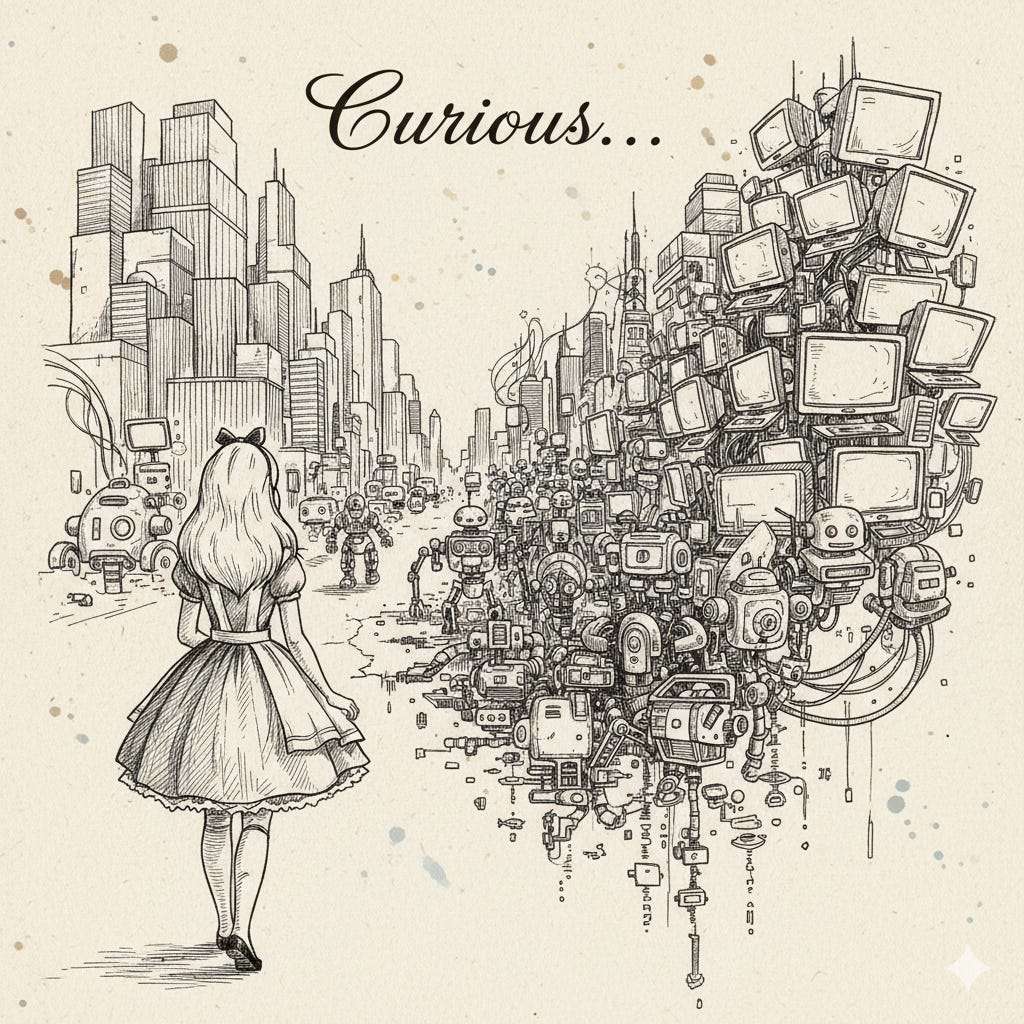
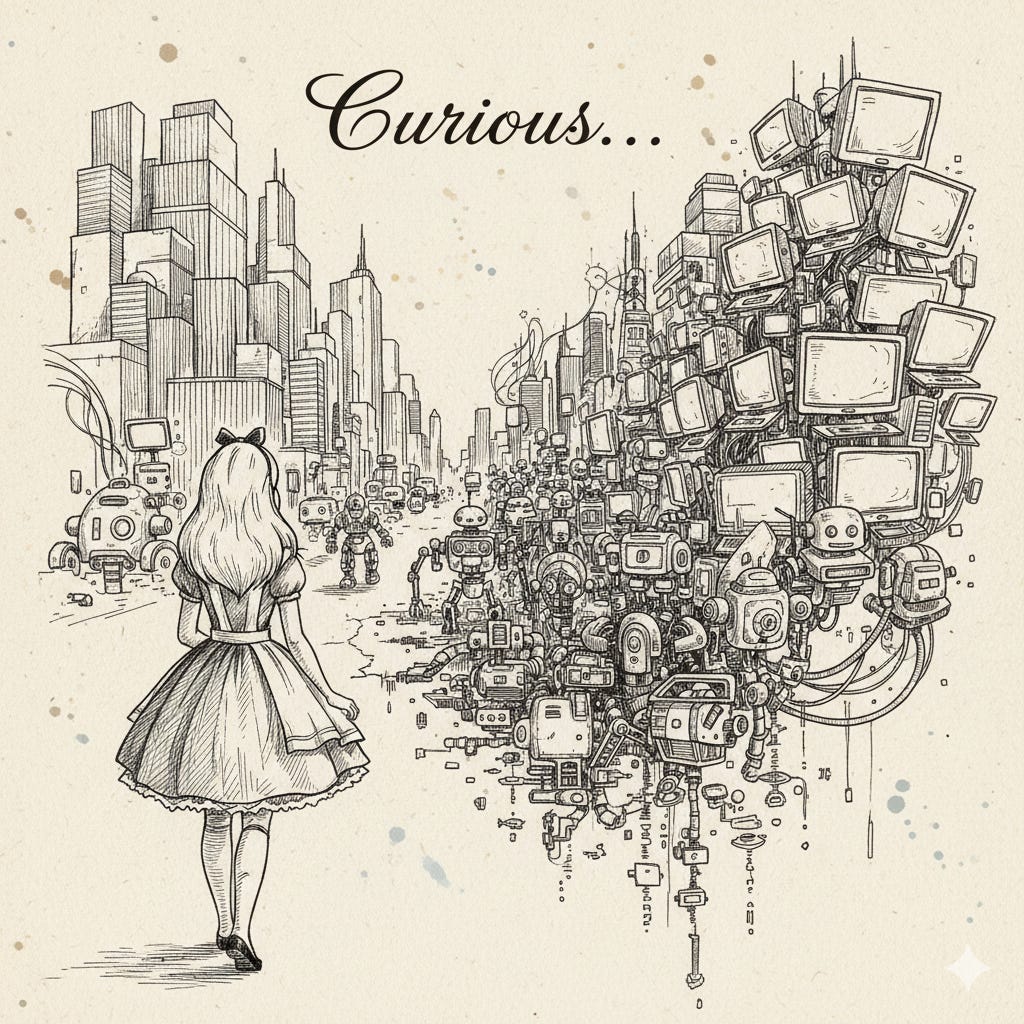
Curiosity Is the Only Superpower That Matters Today
You can learn anything, but you have to be curious first. Without curiosity, skills are just checklists on a resume.
Update Nov 19: Here is the link to Mark’s newsletter/post mentioned below here on Substack.
After almost nine months on the job search, I’ve had a lot of time to think about what I’m good at, where I fit in. Too much time, maybe. I’ve spent months refining my pitch, tweaking my resume for the ATS bots, drafting cover letters that would pass through the filters and still be “me,” and trying to answer the question: Why should you hire me?
I started off this whole process focusing on the things I know I’m good at. The hard skills. Content strategy, writing, editing, podcasting. I know how to find a story in a messy transcript. I’ve built a career on translating complex technical concepts—whether it’s how a bus dispatch system works or how to set up a blog—into something that people actually want to read.
And I still think that’s true. That is my “superpower,” and I lean on it in everything I do. From teaching to workshops to just helping people with questions. As my job search dragged on, I started layering in the other stuff I’m good at: marketing, strategy, product fit, AI, leading people with empathy, my ability to spot a problem and hack together a solution. Things that round out the bullet points on my resume and cover letters.
But this morning, something clicked. I was reading Mark Schaefer’s newsletter this morning as I sipped my first cup of coffee—today focused on “soft skills” in the AI Era—he’s always a good read, but today was different. He was reflecting on his new grandson and the world this he is going to inherit. As I was reading, Mark highlighted what he believes will be the number one “soft skill” for the AI Era.
Curiosity.
It stopped me cold. It made me pause and look past the “skills” and the “experience” sections of my CV. It made me think about, as I read through various job alerts, the “why” to hire me. And it’s not any single skill. It’s not any single job. It’s not even all my accomplishments.
When I look back at the single, consistent thread running through my life—decades of it, since college and probably even high school—it isn’t “writing” or “tech.” It’s curiosity.
It’s the insatiable need to ask, “How do I get my Mac to do this?” or “How do I fix this problem in the lab?” or “I wonder if there’s a tool that can do this for me?” and find the answer. A drive that sometimes pulls me down tech rabbit holes and away from the job at hand, but often getting lost is when you find the gem you’re looking for.
If you want to know who I really am as an employee, as a person,—someone who empowers teams to be creative, keep testing things, and keep asking questions—you have to look at the history of that curiosity.
It started with charcoal and epoxy
Back when I was running a lab at Duke University during the “scientist” chapter of my life, we had a tedious problem. We needed to reconstruct fire histories from lake sediments. This involved staring into a microscope and counting charcoal particles in lake sediment suspended in slides embedded with epoxy.
I remember sitting there, hours on end, thinking there had to be a better way.
I can’t even remember the name of the program we were using, but I started tinkering. I wondered: Could I have a computer analyze the image I’m seeing? We have a camera hooked up to the microscope, what could it see that I couldn’t? Based on what I know a piece of charcoal looks like—it’s usually angular, quite dark, specific opacity, distinct color—could I train a computer to find those specs, measure them, and count them for me?
Now, this was the early days of computer vision, so ultimatelyt didn’t work out very well. The hardware and software just weren’t there yet. But I found some amazing things in the process. I ran interesting tests. And I know that if I had stayed in that lab, I would have kept pushing until I found a new application for it.
The pivot to the web
I eventually left the lab to go into frontline tech support. That curiosity served me well there, helping people solve their computer problems. But the real pivot—and I’ve told this story before—happened because of my friend Derek. One day, I looked over his shoulder. He was typing code into Notepad. Just plain text.
“What are you doing?” I asked.
“Writing a webpage,” he said.
“Can you teach me?”
That was it. That was the spark. I started learning HTML, and that opened up a whole new world of “I wonder if…” How do I make this page look better? I saw someone else do this cool thing with JavaScript; can I figure out how they did it? Could I make a page with simple answers to computer problems for people to help themselves?
That inherent curiosity for science and systems made me an integral part of product marketing teams later on. When I was building websites for pharma, I wasn’t just a “web guy.” I was asking questions like a scientist, trying to understand the product deeply so I could make the experience better for the user. This, unknowingly, planted the first seeds of my later pivot to marketing.
From blogging to Vibe Coding
The next big leap was blogging. I was curious if this new tool could help me express my interests. Then podcasting came along in the early days. Why not? Let me try this. Then photography—I’ve taken photos since I was ten—but when digital cameras arrived, I had to know how to push the software to make the images sing. I dove into not just software, but the how and what made a good photo.
And now? Now it’s AI. Going from simple questions and basic prompting to more and more complex tools and workflows.
While I was working at Modaxo, managing the Transit Unplugged podcast, I started looking at our listener data. I realized it had a remarkable similarity—in structure, time series, and categories—to the climate data I used to crunch for my Master’s degree in Paleoclimatology. The curiosity kicked in again.
I wonder if I can use the same multivariate statistical tools I used for my thesis on this podcast data?
And you know what? I could.
I didn’t know Python well enough to write the code from scratch. But I knew what questions to ask. I fired up Copilot and VS Code—vibe coding before I even knew the term—and I started generating the visualizations I needed to see the statistical results. Because with multivariate stats, you really need to see the graph for it to make sense. The analysis didn’t reveal anything really new, but it did show me that I could do a lot more with AI than ask for blog post ideas on transit planning or getting a quote from a transcript.
And that has just kept going. Can I do this with Gemini or ChatGPT? What can I integrate that would give me time back to work on meatier problems? Can I build a workflow for this? Can I run an LLM locally on my machine? Sometimes—often—the experiments fail. My attempts to build AI agents in Opal don’t always work.
But the process? The process is always worth it, because I’ve always learned new things along the way. I might not have solved the problem I set out to, but I picked up a few things that will solve other problems I’m working on.
Why this matters to you
Here’s the bottom line.
If you are looking for someone who can write stuff, or someone to create a go-to-market plan, or someone to manage your ads—I know you can find those people. There are hundreds of them. Lots of great people out there looking for work.
But I you’re not going to find many people who are so insatiably curious about the world, about how things work, and about technology, that they are always asking, “I wonder if” as I am. The ability to tinker with tools. Not afraid of the command line. Not afraid to push and to learn new things on a daily basis.
That’s my actual superpower.
I’ve learned the other things. I can write well. I can build websites. I can produce podcasts. I can crunch data. But it’s the curiosity that made all of that possible. Without curiosity, no matter how smart someone is, they won’t push the boundaries. They won’t figure out how to grow the company or the brand because they aren’t asking questions. Asking the right questions.
They aren’t trying to go, “I wonder if,” and finding out.
Sometimes you’re wrong. Sometimes you break things. But the rewards are always there.
So, if that appeals to you, let’s talk. You know where to find me.
Message Tris Hussey
P.S. As I was writing this, Google dropped Gemini 3 and Antigravity, so of course I have installed Antigravity and anxiously awaiting when Gemini 3 shows up for me. Curiosity never rests!
Originally published at https://trishusseywriting.substack.com/p/curiosity-is-the-only-superpower