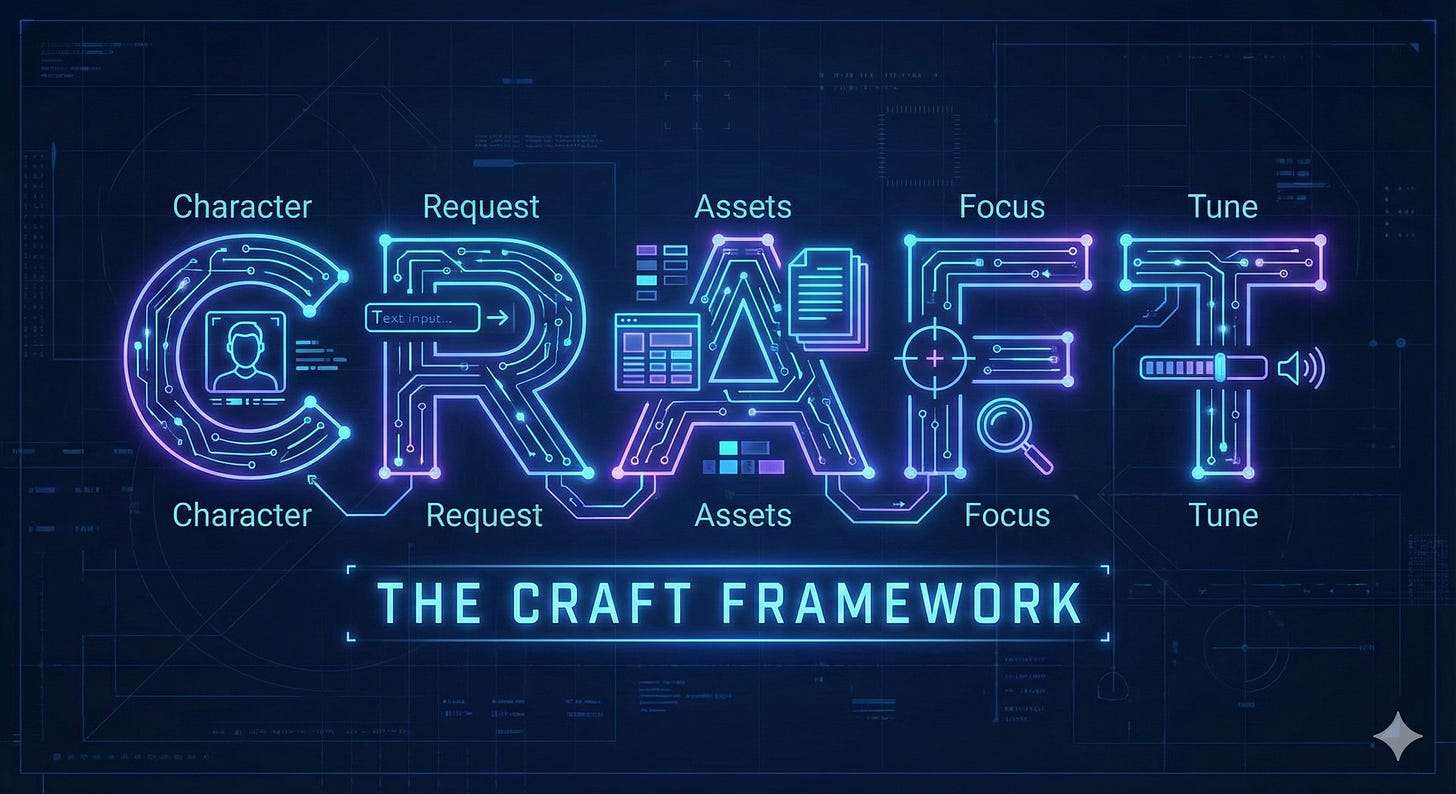
The CRAFT Framework: Practical AI Prompting for Marketers
To get more out of AI, you have to put more into it.
CRAFT gives you a framework for giving AI tools the context they need to do the job. Plus bonus free, no strings, no email download at the end.
I think we all started out the same way using generative AI. We heard about ChatGPT and how amazing it was for helping draft emails and blog posts and the solution to world hunger. And we put something like this in the prompt box:
“Draft an email about our new product.”
And got a hallucinated mess with an over exuberant number of emojis and cliches. We have an idea for a blog post, throw a few points in there and ask for a draft. It’s not terrible, but it’s not great either. Then in the final paragraph…
In conclusion…
In conclusion? The only people who still write like that are high schoolers trying to hit a word count or first-year college students panic-writing at 2 a.m. It’s not how professionals write. It’s definitely not how good marketers write.
All these simple, hopeful, and ultimately useless prompts make us a little jaded about AI. Then we learn a trick or two. We pick things up from others. We try a really good prompt someone selflessly shares somewhere. That’s when we realize that getting good results from AI isn’t magic—it’s a process.
It’s a framework.
How do I summarize my process into a framework?
I’ve been refining my own process for a while now, standing on the shoulders of giants like the amazing folks at Trust Insights (Christopher S. Penn , Katie, John, Kelsey—if you aren’t following them, you should be). Inspired by their frameworks, I wanted to build something that would act as a mental checklist for me—and for you—to ensure every prompt hits the mark.
I had five things I knew my framework needed to have:
- Who are you? (the AI)
- What do I want you to do?
- Other information I’m giving you to work with
- Who is it for?
- What am I missing?
What I didn’t have was a nice word to bring it together. Come on, a good framework has to have a cool acronym.
I asked Gemini to help me brainstorm acronyms for my framework. It gave me ten options. All were geeky (good), but there weren’t any good puns (dang it), and frankly, most were terrible. But a couple stood out—PRIME and CRAFT.
My virtual AI personas both liked CRAFT, I wasn’t so sure, so I drafted a version of this post using PRIME (Persona, Request, Inputs, Market, Enquiry). After getting to “Market” I knew it wasn’t going to work, “Enquiry” was the final nail in the coffin.
So CRAFT it is. Which stands for: Character, Request, Assets, Focus, Tune.
Because that’s what we do as marketers—we craft. We are craftspeople. We create. We build. Why Gemini said this was something that was inspired by RPG and Gamers I have no idea. I think the creating angle is much better. Anyway, let’s dive into the framework, shall we?
C is for Character
The first step is always setting the AI’s character. Who are they? What is their expertise? Who is the AI supposed to be?
If you don’t give the AI a role, it pulls from the entirety of human knowledge. That’s too broad. It’s like asking a random person on the street to write your B2B whitepaper. You need to narrow the scope of the model—reduce the probabilities—to a specific domain.
Give it a real role. Something that you would use to describe the person you would ask to do the job: “You are a marketing expert specializing in B2B SaaS email campaigns.”
Now, the AI isn’t just a text predictor; it’s a specialist. It knows the jargon, the tone, and the expectations of that specific role. It frames everything that comes next.
R is for Request
Now that the AI knows who it is, tell it what to do. This seems obvious, but people often bury the lede and confuse AIs with seemingly conflicting tasks. Be specific. “I’d like you to draft a landing page for our new product release that will attract customers to sign up for a demo.”
Simple. Direct. Focused. It pivots from the character directly into the action.
A is for Assets
This is where most people stop, and where most prompts fail. You can’t expect the AI to give you a great landing page about your product without anything to go on. You need to give it Assets. Assets give the AI more context for what it’s doing. It has grounding in your product, what it does, and who it’s ultimately for (your ICP).
- “Here is our product documentation.”
- “Here is a list of key features.”
- “Here are the release notes.”
- “Here is our Ideal Customer Profile (ICP).”
- “Here is our website style guide for how content is written.”
These are your knowledge blocks. By feeding these assets into the prompt, you are building a space for the AI to play in. You are telling it: “Use this information, not your best guess or what you think would be helpful.” You’re narrowing the probability set down to your specific task and need.
A lot of prompt frameworks skip or gloss over explicitly adding documents as context, but it doesn’t have to even be a document to be an “asset.” Even something as simple as “these LinkedIn posts had the best engagement [pasted posts], use these as a template for a new set of posts based on our latest blog post…” gives you a much better outcome than if you didn’t include them.
F is for Focus
We often assume the focus is on us, the prompter. But that’s rarely the case. If you are asking for a summary of a report to read yourself, then yes, it’s for you. But if the output is an email to a client, a proposal for a prospect, or a blog post for your customers, that person is the focus. This small distinction changes the tone entirely.
If I’m doing deep research on a client or industry to build an AI persona, I tell the AI: “This isn’t for me. I don’t want fluff. I don’t need ‘human-readable’ prose. I need raw data, sources, and density. This will be used as a knowledge block for another prompt to understand the client better.”
If I’m researching for a client, I tell the AI: “This is for a busy C-level executive who values brevity and bottom-line impact.” I might even take the “no fluff, just the facts ma’am” report and ask for a two page summary—because it’s often so detailed even a two page summary is pretty rich.
Defining the audience of the output, means your prompt starts to adjust the response for the person ultimately using the output—even if sometimes it’s for a prompt to feed back into the AI.
T is for Tune
This is the secret sauce. This is the “human in the loop” that makes AI powerful rather than just efficient.
I borrowed this technique from Christopher Penn, and it has saved me from more bad outputs than I can count. I end most of my prompts with this instruction:
“Ask me one question at a time until you have enough information to complete the task at hand.”
This creates what Robert Rose calls Valuable Friction. It forces a pause. It stops the AI from rushing off to do what it thinks you want, and instead makes it ask, “Hey, have you thought about this?”
Valuable Friction is a great book, by the way, you should add it to you reading list along with Christopher’s latest on using AI. I’m not getting anything from these links, btw.
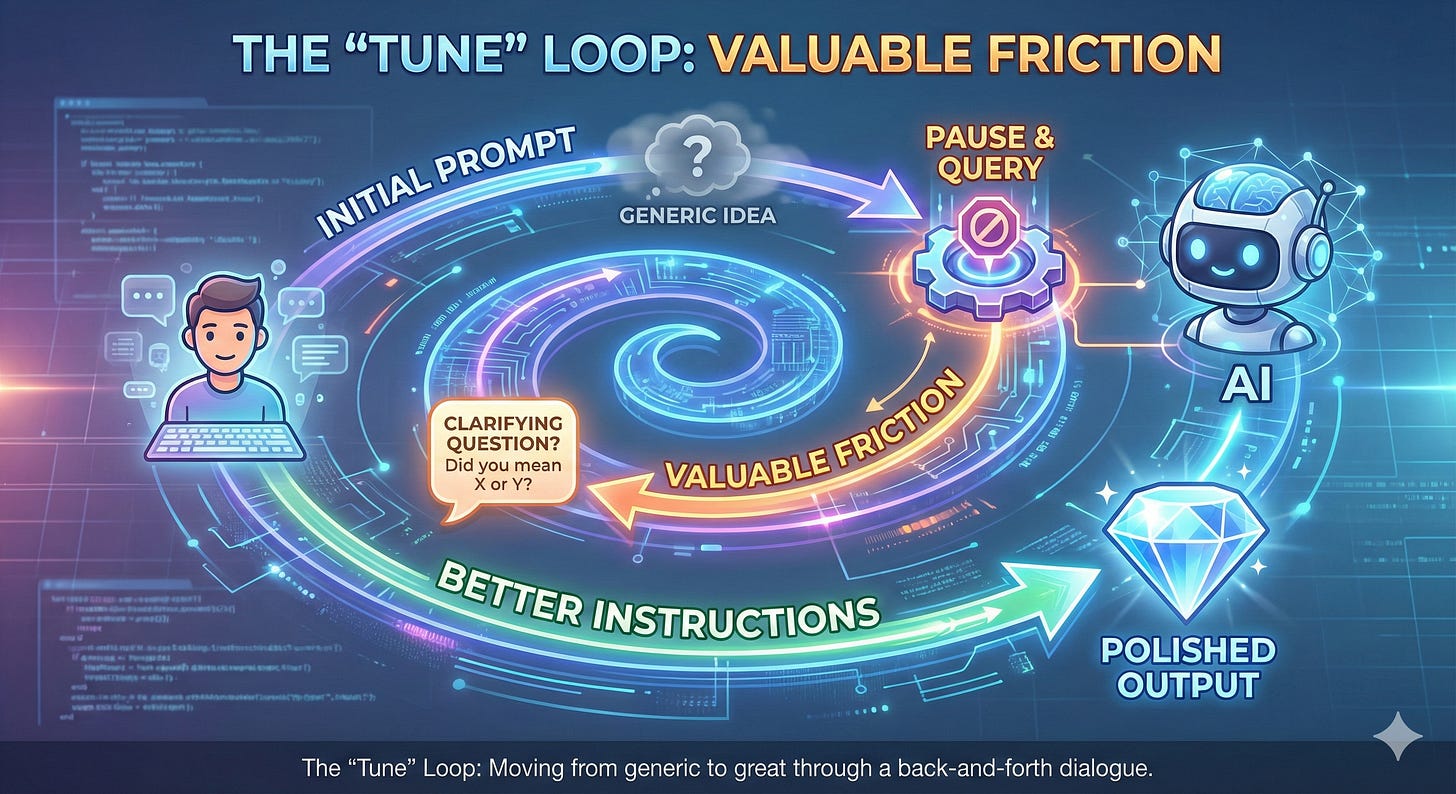
I find this process tremendously powerful and helpful. AI is great at uncovering my blind spots. Maybe I forgot to specify the word count. Maybe I didn’t clarify the call to action. Often when I’m prompting to make a prompt, I get “Have you thought about this use case or situation?” And that always makes me really think about the task at hand. I’m not writing a prompt, hitting enter, and grabbing a coffee; I’m intimately connected to the process.
Other frameworks use T for Tone, but I think Tone is part of setting up the Character. In my framework, T stands for Tune, because you get much better results when working with AI is a conversation, not a robotic answer machine. This Tuning phase turns the process into a dialogue. It ensures that before the token meter starts running on the final output, we are both on the same page.
CRAFT in action
Here’s what I mean. Three prompts that should all fit together, but without using the CRAFT framework, you’re going to get stuff all over the place.
1. The Deep Research Report
The “Old Way” Prompt:
“Research the current trends in AI in time keeping for agencies and write a report.”
The CRAFT Prompt:
- Character: Act as a Senior Market Research Analyst specializing in MarTech.
- Request: Conduct a deep-dive research report on the adoption of AI-enabled time keeping in mid-sized marketing agencies. I need a report that covers risks, opportunities, and projected growth for 2025.
- Assets: Use the web to search for reports from Gartner, Forrester, and HubSpot published in the last 6 months. Also, reference the
[Attached Internal Strategy Document]for our current stance. - For: The report is for our VP of Strategy. She hates fluff, loves data, and needs bullet points with citations.
- Tune: Before you start researching, ask me questions to clarify the scope and format of the final deliverable until you’re clear on the goal.
2. The Product Launch Blog Post
The “Old Way” Prompt:
“Write a blog post about our new scheduling software, TimeKeeper.”
The CRAFT Prompt:
- Character: You are an empathetic conversion copywriter who loves storytelling.
- Request: Write a 1,000-word launch announcement for our new software, “TimeKeeper.” The angle should be about “reclaiming your sanity,” not just saving minutes.
- Assets: Here are the
[Product Release Notes]and a transcript of[Customer Beta Feedback]detailing what they loved most. - For: Overwhelmed freelance graphic designers who struggle with work-life balance.
- Tune: Ask me questions one by one until you understand the specific tone and Call to Action (CTA) I want to use.
3. The LinkedIn Post (Repurposing Content)
The “Old Way” Prompt:
“Write a LinkedIn post based on that blog post.”
The CRAFT Prompt:
- Character: You are a Ghostwriter for a tech CEO with a punchy, contrarian style.
- Request: Take the “TimeKeeper” blog post we just wrote and repurpose it into a text-only LinkedIn post. It needs a strong “hook” in the first line to stop the scroll.
- Assets: Use the
[Blog Post Text]generated above. - For: A mobile-first audience of agency owners scrolling during their lunch break. They skim, so keep paragraphs short.
- Tune: Please generate 3 potential “Hooks” for me to choose from before writing the full post.
While you’d run all these prompts separately, you can see how using CRAFT allows you to chain the responses together into a very nice cohesive whole.
Go forth and create
That’s the CRAFT framework. Something simple that helps guide my prompts—and meta prompts—to give me better, and more consistent, results.
- Character
- Request
- Assets
- Focus
- Tune
It might not be earth-shattering, but it’s a perspective that adds richness to the process. It moves us away from “AI is a magic black box” thinking and back to the craft of marketing.
Give it a try on your next prompt. You might be surprised at just how good the results can be when you treat the AI like a collaborator and not just like an information butler.
Free, no strings, no email download
By now you know that I go through rounds of feedback with AI personas on my content. For this post it suggested a simple one-page template you can download and use. So…
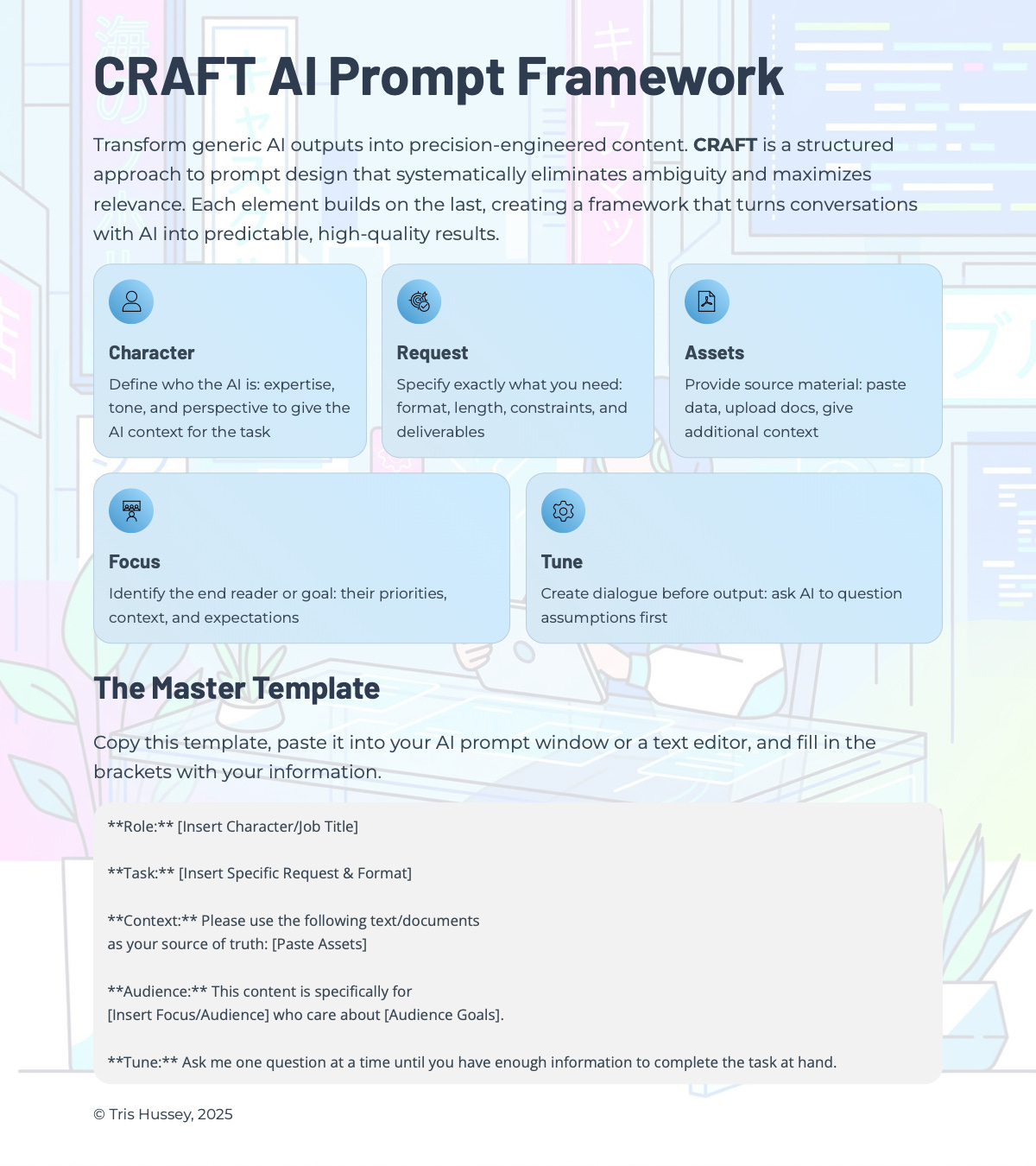
I made this not only as a cheat sheet, but something you could attach to a prompt to help improve the prompt itself (inspired by the Trust Insights CASINO download):
“Review this one page summary of the CRAFT framework and adjust my prompt to match it.”
Hope you enjoy it. Let me know in the comments what you think.
Originally published at https://trishusseywriting.substack.com/p/the-craft-framework-practical-ai