Not Every Problem Needs a Smart Solution
Or how imploding an Artifact reminded me to not overthink things
If you’d like access to the premium content mentioned, subscribe to 30 Plus Days of AI on Substack. The link to the smarter CRAFT prompt builder is at the end of the post. It’s an Artifact and takes the “dumb form” inputs you see in “prompt generators” and recommends a better version based on what you started with.
On Day 11 of 30+ Days of AI, I wrote about custom GPTs and Gems. In that post, I really dismissed Claude as a good solution for what I wanted to do and explain. Even the explanation from Claude itself was confusing to the point of unhelpful. Admittedly, I hadn’t played with Claude much at that point, but even now that I have, and am chomping at the bit to upgrade my account from free to paid, I still think that Claude doesn’t have a good match for custom GPTs or Gems. I have some experiments to do with complex prompts that need a lot of user input that maybe could be a Skill.
More on that later.
I asked Claude to explain the difference between Artifacts, Projects, Gemini Gems, and Custom GPTs. The answer confused me so thoroughly that I walked away thinking Artifacts were basically saved prompts.
Which, to be fair, wasn’t entirely wrong, but it wasn’t right either. It described what Artifacts are without explaining what they do. Like describing a drill as “a rotating tool” and leaving out the part where it makes holes, but to make holes you need a “drill bit,” oh but it can drive a screw or nut into place too, oh but you need a different tool for those jobs.
The Devil is in the details people.
Which brings me to the crux of this post—I wanted to share some work with a team of people, but I didn’t want to give them the whole prompt. I saw two ways I wanted to try to tackle the challenge—only one worked.
What I actually needed to figure out
I’m working with the Peak Intelligence team—the folks behind Basecamp Canada, the AI literacy series I’ve been helping with. I wanted to help the marketing and content development by creating virtual customer personas. Personas like Millie, Alex, Lindsay, and Morgan, so they can actually talk to someone instead of some vague imagined audience.
The quick persona builder I created with EasySOP works extremely well. It was set up to build personas for Canadian small-medium business people, so I tuned it for a broader market of US, Canadian, and UK AI learners. Because the process asks a lot of questions that I wouldn’t really know the answers to, I wanted to have a workshop to walk people through the process. The thing I realized is I couldn’t give away the IP. While a lot of it is mine, it’s not all mine.
Crap. What now.
It hit me in a blinding flash of the obvious that I should create a Gem for people that I could share (since the prompt is hidden). Then because I’m me I thought I should try to make a Claude Artifact too/instead. I thought it might be “cooler” to have more of an “app feel” than a “boring” chat-based prompt.
I asked Claude to take my persona prompt and make an Artifact from it. Everything seemed cool…until I tested it and the whole thing failed, then imploded, then I gave up. Here’s that story.
The thing I didn’t understand about Artifacts
An Artifact isn’t a saved prompt. It’s a standalone web app that runs inside Claude.
That clicked for me about thirty seconds after I built my first one. I took my transcript cleaner prompt and made a simple “paste in the transcript and clean it” Artifact. It’s just for me, because I don’t think it’s all that awesome, but I finally got it. Artifacts are interactive, they have a UI. It calls Claude to do the thinking, but the user sees a form, not a chat window. They don’t need to know what a prompt is. They just answer questions and get something useful at the end.
The persona builder made sense as an Artifact in theory. First give it the basics (region, research, and learner profile), then walk through four questions to build the persona (which one to build and some refining questions). In practice—it ran into the wall. The persona builder is complex. There’s back-and-forth. There are multiple steps. It needs thinking mode or the output goes generic fast. All of that context adds up, and Artifacts have limits. I hit them.
Hard.
I’d go through the steps and get to Step 6 “Finished Prompt” and get an empty box. I kept trying and eventually I ran out of free account usage allowance, so I had to stop. When I could use Claude again, I tried to figure it out. Yep, the prompt needed too much of the context window and too many tokens to work.
Great.
I did have Claude make the “fix” but I haven’t tried it because I realized that a Gemini Gem was the best way to go. I know it works, I know I can share it without exposing my IP, problem solved.
Except.
Except in my first idea for this post I wanted to show off how cool my persona Artifact was and share an Artifact just for premium subscribers.
Pride before the fall.
When the persona Artifact didn’t work I just about scrapped this post, then I thought I’d try building the Artifact for premium subscribers—a “smart” CRAFT prompt builder.
When an Artifact actually fits
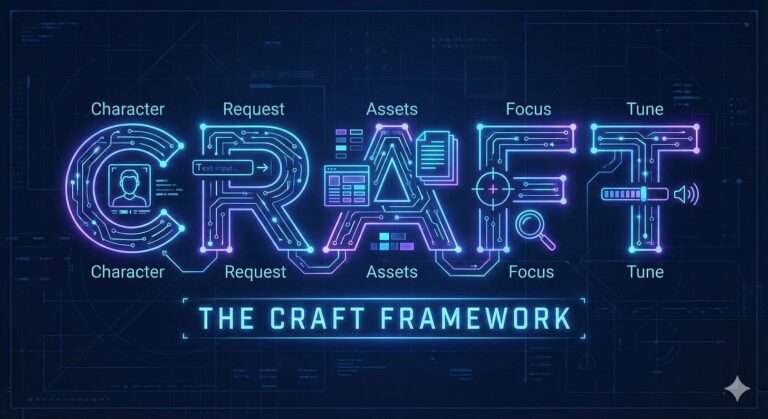
The CRAFT prompt generator is a horse of a different color. CRAFT is a framework for building better AI prompts— Context, Role, Action, Format, Tune. I have a “dumb version” of it on the companion website—30 Days of AI Companion. You fill in the five parts, it formats a prompt. No thinking required. You put in crap for each section, you’ll get a well-formatted crap CRAFT prompt.
But that “dumbness” is fine for an Artifact like this because to make it “smart” there isn’t much Claude has to do: take five inputs, apply some prompting best practices, spit out a cleaner version. That’s well inside what an Artifact can do without hitting a context window or token limit ceiling. If the prompt needs more work, then the best next step is the good old, reliable paste the prompt into your AI chat and ask your AI to help you fix it.
The persona builder needed to learn the person as it went. The CRAFT builder just needs to read what someone gives it. Different job. Different tool.
And it worked pretty darn well.
Why Projects aren’t the answer here either
Projects—at least the way I use them— feel personal. They build context over time. They remember what you’ve done. They learn in a way that makes them useful specifically to you.
Which is not what I want my persona builder prompt to do at all. I don’t want it to remember from one session to another. I might need to create very different personas day to day, even in the same sitting. Even if I want to make a second persona from the flow (the prompt offers three choices, you pick one to start with), you need a certain “freshness” to the interaction.
If I set up a persona builder as a Project, it would start accumulating my context, my working patterns, my history with the tool. Someone else trying to use it would be wrestling with someone else’s ghost in the machine.
The persona builder doesn’t need to learn anything. It needs to run the same way every time, on whatever context the user gives it in that session. Clean slate, every time. That’s not a Project. That’s an Artifact, but not an Artifact because it’s too much.
So it’s a Gem.
The Rube Goldberg check
Here’s something I try to remember—and forget constantly: is there a simpler way to do this? There is an old New England saying:
Give a lazy man a job to do and he’ll find the easiest and fasted way to get it done.
Which is actually a great analogy for software development—Don’t over think it. What’s the Occam’s Razor version of the solution?
A lot of software is over-engineered.
Too many steps, too many dependencies, too much infrastructure for what the job actually is. AI tools are no different. Every back-and-forth, every added step, every “it needs thinking mode or it falls apart”—that fills up the context window, that uses up tokens. If you’re paying for API calls, that’s money. Sometimes a lot of money, before you’ve even noticed what’s going on.
I’ll stand by that Word started to go downhill with version 6 when it added more publishing tools. Which is why I write in a simple Markdown editor (Ulysses).
The honest question to ask—and you can ask it directly to the AI—is “am I using the right tool for this problem?” Not every prompt needs to be an Artifact. Not every Artifact needs to be a Project. Not every Project needs to be a Gem.
Even if you have to draw it on a piece of paper, outline what has to be done at each step, then figure out the best way to get there.
The right container depends on what you’re actually trying to do.
Simple prompt you want to share without exposing your IP? Artifact.
Complex prompt you want to share and protect your IP? Gem.
Context you’re building for yourself with a prompt, files, and memory for ongoing work? Project.
Prompt that can just do its thing and be done? Skill.
Want to try the smart CRAFT builder?
Subscribe on Substack to get access. It’s just $5/mo for a lot more than just my silly artifact.