Google is Finally Beating Microsoft as a Leading Workplace App
Gemini 3.0 and the rest of Google’s AI tools are eating everyone’s lunch—Microsoft’s included—and that will change how work gets done in the AI era.
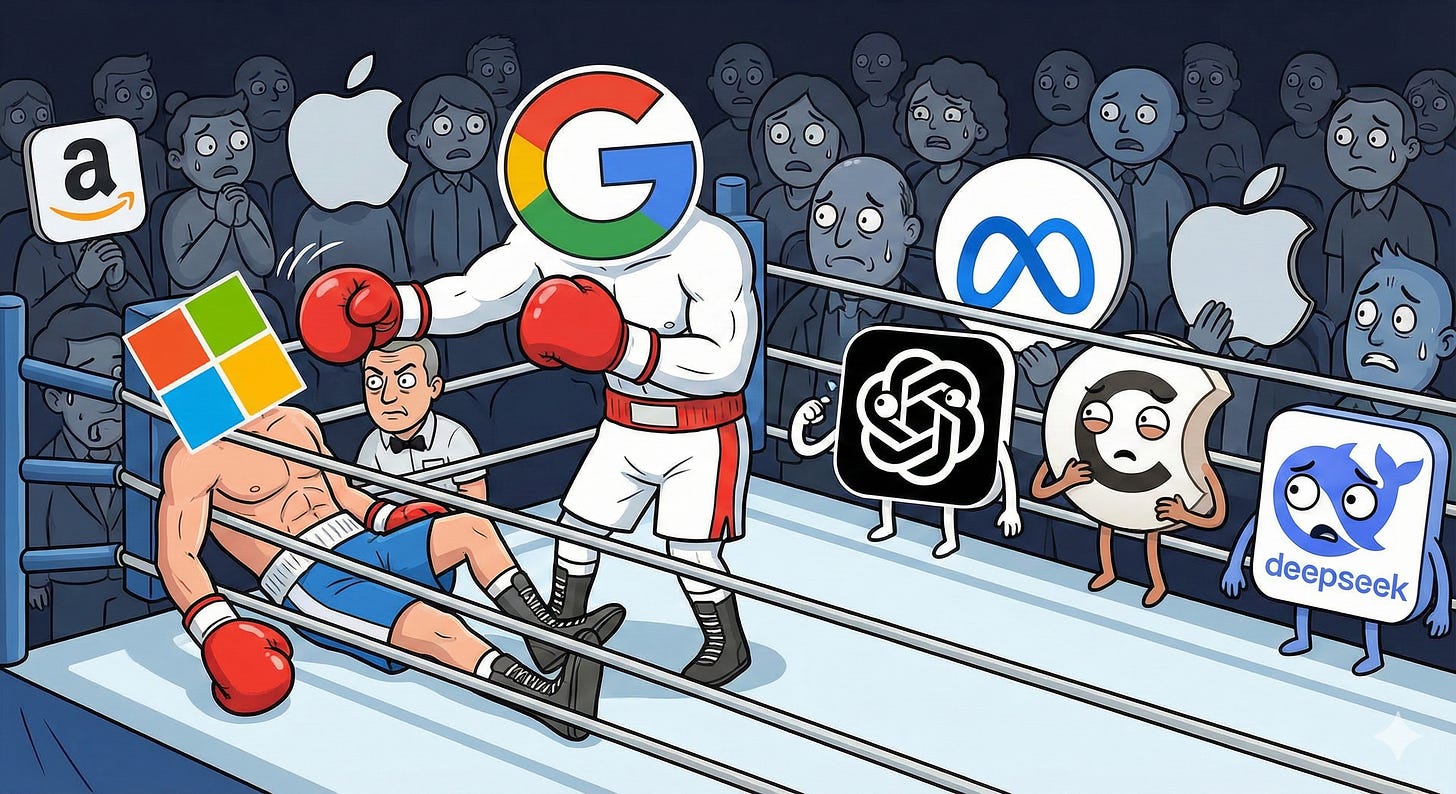
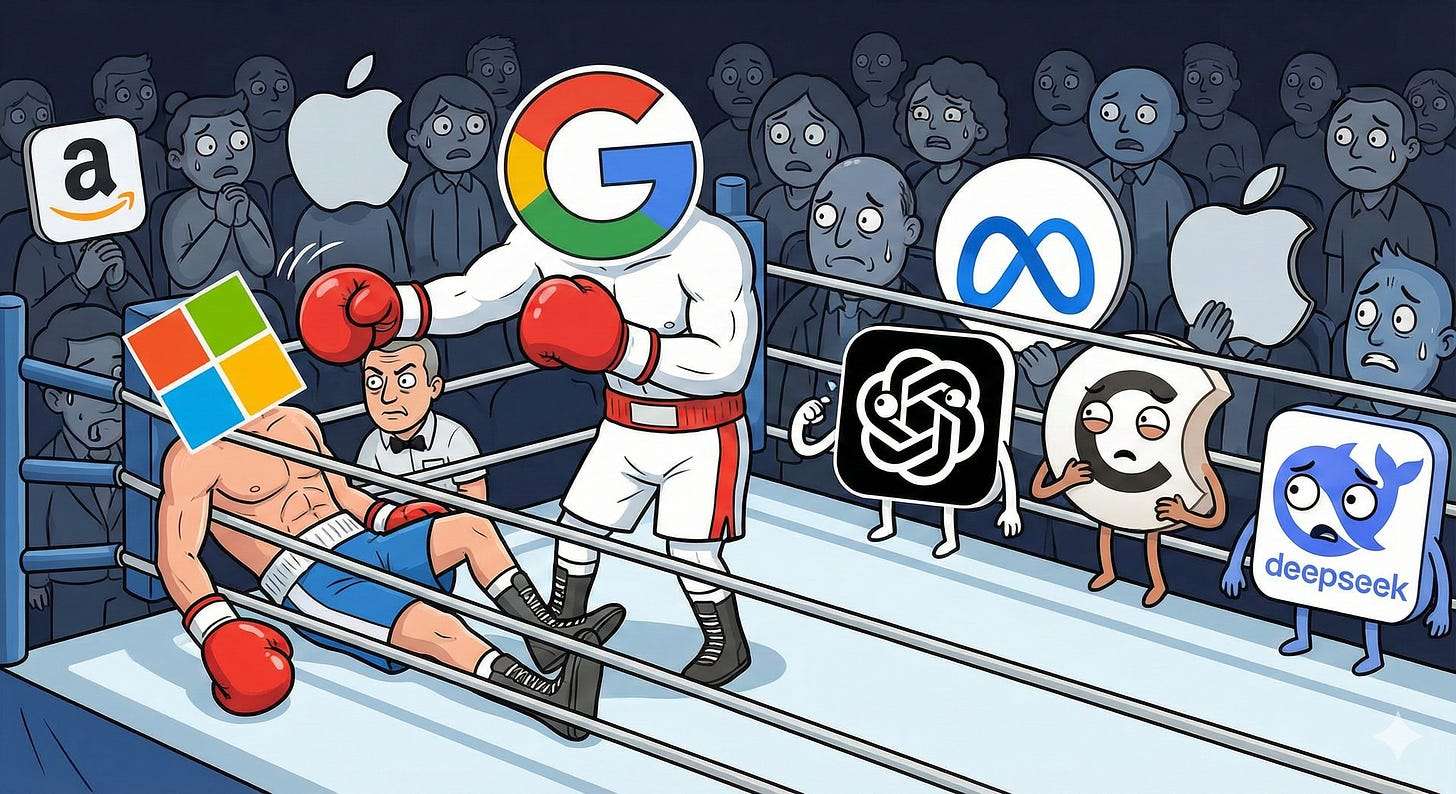
Microsoft is on the ropes. Who’s next to step into the ring?
There has been a lot of chatter about Gemini 3.0 knocking the socks off, well, pretty much everyone. Jeff Livingston wrote a post about how excited he was—and how Google has really changed the game—with the new Gemini integrations into Chrome. Of course, they’re only available in the US right now, so I’m anxiously waiting for them to show up here in Canada. But reading Jeff’s take got me thinking about something bigger than just a browser update.
It got me thinking that Google, and specifically Google Workspace, is positioning itself to become the default “workplace” for the next internet age—thhe age of AI.
The Ghost of Monopolies Past
I’m old enough to remember the first versions of Microsoft Word and Excel. I remember when Internet Explorer was the de facto browser we all had to design for. Ironically, none of the “cool kids” actually used IE for more than testing. It was a pretty sad browser even for back then.
From that era right up into the antitrust suits, Microsoft was just the standard for how work got done. You used MS Office. You used Word, Excel, and PowerPoint. Even today, when we talk about doing a presentation, we ask, “Do you have a PowerPoint ready?” even if we aren’t using PowerPoint. It’s the Kleenex of productivity.
Back then, Microsoft’s dominance stifled competition. I remember trying to use alternatives like OpenOffice or Zoho roughly 20 years ago to save money. I’d do a presentation in OpenOffice, send it to a client partner, and they’d ask, “What did you do to our deck? It’s awful.” The compatibility issues were a nightmare. You had to use Microsoft tools.
I think we are standing on the precipice of that kind of shift again. But this time, it’s Google holding the cards. And AI is their ace in the hole.
Google is Playing for Keeps
In the last month—certainly the last two weeks—Google has upped the game for using AI productively at work by an order of magnitude.
It doesn’t really matter which specific model strength you look at; Gemini 3.0 is frankly amazing. What they’ve managed to do is create an entire work ecosystem based on their tools that actually works. Is it perfect all the time? No. Is it always feature-complete? No. It took a long time for us to be able to generate slides from Gemini directly.
But the momentum is there. Granted, Docs, Sheets, and Slides don’t seem to be getting much love in the updates department—though really how much more do we need them to do—but Gemini is starting to make up for any product gaps that truly remain.
Compare that to Microsoft. They’ve touted how great Copilot would be for people using MS Office, and I’ve sat through their demos a number of times. I watched Excel do things I had to vibe code. I watched documents become slide decks, then summary emails, then a forecasted analysis. Mind blowing stuff. Enough to get anyone to slap down their money and dive in.
Too bad those Microsoft demos were able as close to reality as those pictures of Big Macs at McDonalds. No one, not ever, has seen any of those burgers look like they do in the pictures. And Copilot, even after using it for several months at the end of 2024 and this fall, still doesn’t measure up.
Christopher S. Penn often says—on LinkedIn, Substack, and Slack groups—that it doesn’t really matter which model you use. Just pick one, learn it, and you’ll be fine. They all have different strengths, but they are all generally amazing.
Except for Copilot (he doesn’t say that specifically).
In my experience, it is just not a good model to work with compared to pretty much anything else. While Google is rolling out massive improvements to NotebookLM—deep research tools, creating infographics, generating audio overviews, and making slides—Microsoft is struggling to catch up.
And losing.
The Value Proposition That Made Me Switch
I wasn’t always a Google Workspace and Gemini convert. I didn’t really like working with Google Docs and the other tools until very recently. The real switch happened for me in the spring of this year, when I realized I needed to pay for an AI tool to keep my workflow moving.
I had been using ChatGPT, but I was running into the prompt limit constantly. I’d be in the middle of a workflow—generating images, analyzing data—and hit the wall. “Oh, I need to get stuff done.” I’d try switching accounts, but that just messed everything up.
When it came time to pull out the credit card, I looked at the value.
- ChatGPT Plus: $20 USD/month (which is like $30+ CAD). You get the model. That’s it.
- Google Workspace Upgrade: For a little over $20 CAD, I could upgrade my Workspace account. This gave me Gemini Pro, but it also gave me more storage in Google Drive, allowed me to use my domain for Gmail, and unlocked deep integrations across the apps I was already using. A no brainer.
The cost-to-value ratio wasn’t even close. And I certainly wouldn’t be getting the massive improvements in NotebookLM with ChatGPT. Are there things I’d love to see in Gemini that other tools have? For sure. Enough to spend more and get less? Yeah, no.
Is Google the New Monopoly?
So, is Google in trouble in the “monopoly” kind of thinking? They’ve already faced FTC challenges regarding Chrome and ads. But the world has fundamentally changed since those were filed.
When you look at some of the different units of Alphabet now:
- Chrome: The underpinning of everything (and the delivery vehicle for Gemini).
- Search: I’ve been using AI-enabled search for about a month, and I love it. It misses the plot sometimes, but generally, it’s solid.
- Ads: This is the moneymaker, but it’s going to be interesting to see how AI results impact click-through rates.
- Workspace: Drive, Docs, Slides, Sheets, NotebookLM, and more.
When you view Google through that lens—their potential to control and direct how people experience the internet and get work done—it feels very 2003 Microsoft.
If I were setting up a company today to be AI-forward and AI-enabled, Microsoft 365 would not be my first choice. It would be a distant second because there isn’t really another option. But Google is where I’d set up shop.
It’s not like people are going to stop using Microsoft products overnight. But for the actual work? For the thinking, the creating, and the collaborating in an AI world?
Microsoft and Copilot are being left behind. It’s Google’s game to win.
And while OpenAI and Anthropic are launching great models, even they are scared, and with good reason. They are building tools. Really great tools, especially Claude for coding, but a single thing. Need to take that research summary and build a presentation from it? Can’t do it in either tool. Gotta switch to M365 or Google Workspace.
And I know, because I watched it happen before, people will stay put in a single set of tools because it’s easy and convenient. I don’t venture far out of the Google space, because I don’t need to. Most of the time it has and does everything I need.
And that is the killer app.
Need help navigating the AI ecosystem for your team?
I help businesses figure out the right tool stack—whether it’s Google, Microsoft, or something else entirely—to get real work done. Book a 30-minute consultation and let’s talk about your AI strategy.
Originally published at https://trishusseywriting.substack.com/p/google-is-finally-beating-microsoft